PokemonReal or fake
How to Tell if Pokemon Cards Are Fake: 8 Checks That Work
How to spot fake Pokemon cards: the card back, text errors, fonts, Energy symbols, foil texture and edges, plus the warning signs on sealed packs and boxes.
We earn from qualifying purchases through links on this page. How we make money.

At a glance
- Most reliable single check (TCGplayer)
- The card back's blue border and colors
- Text red flag
- Pokémon spelled without its accent
- Price red flag (Pokemon Support)
- Far below the suggested retail price
- Most reported source of fakes (Pokemon Support)
- Flea markets
Check the back first: on a fake, the blue border often bleeds into the rest of the design or the colors look washed out. Then read the front for spelling errors, “Pokémon” without the accent on the e, wrong fonts, odd Energy symbols or impossible HP. Flat foil and rough edges are further signs. No single test is conclusive.
That last point comes from TCGplayer’s own guide, which says no trick or method for spotting counterfeits is 100% conclusive. The checks below are the ones TCGplayer and Pokemon Support describe, most reliable first. Use several together.
1. Look at the card back
TCGplayer rates the back as the most reliable place to start, because every Pokemon card printed in English shares the same back, apart from a few documented exceptions. Put a suspect card next to one you know is real. Signs of a fake:
- Bleeding between the blue border and the blue in the rest of the design.
- Washed-out colors, or a back that is darker or lighter overall.
2. Read the text for errors
Counterfeiters often get the words wrong. TCGplayer lists these red flags:
- Spelling or grammar mistakes in attack names or rules text.
- The word “Pokémon” printed without the accent over the e.
- HP or attack values of 1000 or more, far above anything printed on a real card.
3. Compare fonts and symbols
Lay the card beside an online scan of the same card from the same set. Check:
- Font and size of the name, HP and attack text.
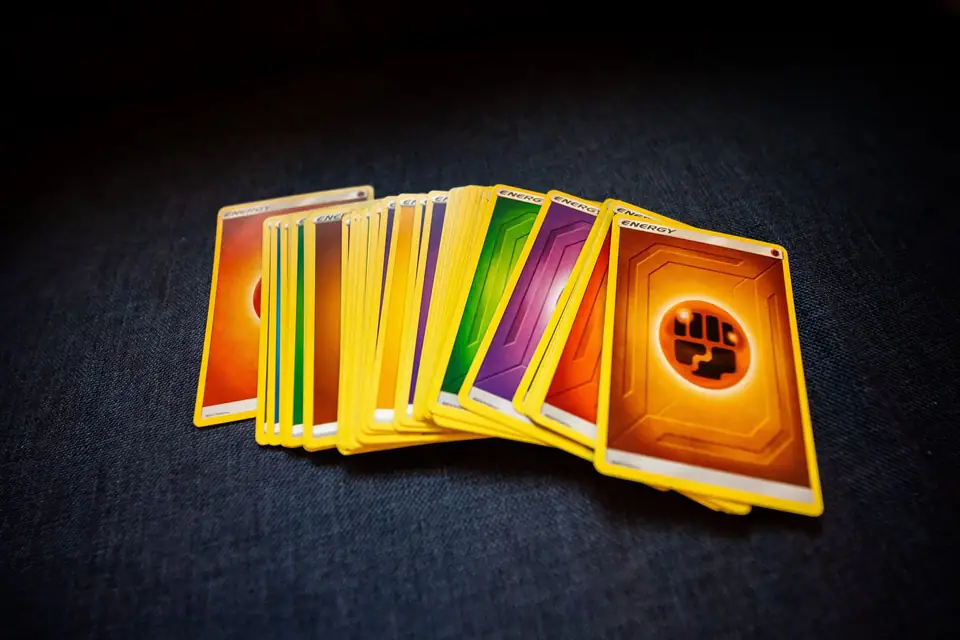
- Energy symbols: the right type and the right size.
- Numbers: HP, damage, Weakness and Retreat should match the scan.
- Set symbol and card number: they should match the set the card claims to come from.
4. Feel the foil and check the edges
TCGplayer points to flat, untextured foiling where the real card’s foil style should leave a texture. It also notes that the edges of a real card are straight and clean, with no cardboard residue.
5. Use the light test with care
Pokemon Support says counterfeit cards “are often easy to see through” when held up to a bright light. TCGplayer does not recommend relying on it, because too many cards give false results. Treat it as one clue, not a verdict.
Skip the damaging tests
The rip test and the bend test both damage the card. TCGplayer says it has not confirmed the rip test is reliable, and a torn real card is a ruined card. Use the checks that keep it whole.
6. Check sealed packs and boxes before you open them
Fakes are not only loose cards. Pokemon Support says fake booster packs are often very difficult to tell apart from real ones, and suggests comparing them with product images on the official site. TCGplayer notes that booster boxes come in soft cellophane with a Poke Ball logo, and that real packs have straight, flat edges along their seals.
Sealed Pokemon booster boxes
Live listings, shown by eBay
Opens eBay in a new tab. Check condition, seller feedback and returns.
7. Weigh up the price and the seller
Pokemon Support calls a pack priced far below its suggested retail price “a near certain warning” of counterfeit goods. It also says its highest reported cases of counterfeit sales come from flea markets. A seller with a long record, clear photos of the actual item and a returns policy is a safer choice than a cheap listing with stock photos.
8. Ask someone who handles cards every day
Pokemon Support suggests taking a doubtful card to a local card shop. For a valuable card, a grading company authenticates the card before it grades it; our guide to how card grading works explains that process.
Where to go next
If you are buying sealed, start with what comes in a Pokemon booster box or an Elite Trainer Box, so you know what a genuine one should contain. Once you have cards you trust, protect them with sleeves and toploaders. Collecting Yu-Gi-Oh! too? How to tell a Yu-Gi-Oh! card’s rarity and edition covers the security foil on every genuine card. Comparing sealed products? See booster box vs Elite Trainer Box.
Frequently asked questions
Does the light test prove a Pokemon card is fake?
Not on its own. Pokemon Support says counterfeits are often easy to see through when held up to a bright light. TCGplayer warns the test gives too many false results to rely on, so use it alongside the card back and text checks.
Should I do the rip test?
No. Tearing a card destroys it whether it is real or fake, and TCGplayer says it has not confirmed the test is reliable. Use the checks that leave the card intact.
Can a sealed booster pack be fake?
Yes. Pokemon Support says fake booster packs are often very difficult to tell from real ones. Compare the pack with the product images on the official Pokemon TCG site, check that the seals are straight and flat, and be wary of a price far below retail.
Who can check a card I am unsure about?
Pokemon Support suggests a local card shop can look at a suspect card. A grading company also authenticates a card before it grades it.
Sources
- Did I purchase fake or counterfeit cards?Pokemon Support
- How to Spot Fake Pokemon CardsTCGplayer
- Expansion Overview: Pokemon TCG Scarlet & Violet, Journey TogetherThe Pokemon Company International
Filed under Pokemon
Read next
Pokemon Booster Box vs Elite Trainer Box: Which Should You Buy?
A Pokemon booster box holds 36 packs; an Elite Trainer Box holds 9 packs plus sleeves, Energy and dice. How they compare, and which suits players or collectors.
What Comes in a Pokemon Booster Box? Packs, Cards and Odds
A Pokemon TCG booster box, sold as a Booster Display, holds 36 packs of 10 cards plus an Energy. What is inside, and how to buy one sealed.
What Comes in a Pokemon Elite Trainer Box? Full Contents List
A Pokemon Elite Trainer Box holds 9 booster packs, 65 sleeves, 45 Energy cards, dice, a promo card and a storage box. Here is the full list and who it suits.
How to Protect Trading Cards: Sleeves, Toploaders, Binders, Boxes
How to protect trading cards: sleeves for play, toploaders for valuable cards, binders for display, boxes for bulk, and the room conditions to store them in.